The Fall Review
By Jesse Hassenger
The Fall tells a story within a story, one being interpreted by an innocent child, and Tarsem does all he can to give us an honest version of this process. Little Cantica Untaru plays the child, Alexandria, in the hospital with a broken arm, and apparently the actress is not fully aware of the filmmaking process, which explains the striking naturalism in her conversations with the paralyzed Roy (Lee Pace). This leaves us unsure of Untaru's acting ability, but blissfully so, compared to the unnerving technique detectable in someone as young as Dakota Fanning.
Roy is a stuntman in roaring-twenties Hollywood, depressed over the loss of his girlfriend to another man, and he spies advantages in befriending this broken but ultimately mobile little girl: Maybe she can fetch him some morphine pills, and maybe he can overdose on them. He entices Alexandria with a fairy tale, stopping at strategic moments to ask for favors.
A chunk of the movie is composed of fantasy sequences as Roy spins a fantastical, sometimes nonsensical adventure story. Improvisation (or is it customization?) leads to countless narrative shifts and leaps of logic, but his story ostensibly concerns a masked bandit (Pace himself) joining up with a crew of international vengeance-seekers: an ex-slave, an Italian demolitions expert, an Indian swordsman (the unspoken disagreement over what this racial designation entails is the movie's best, perfectly underplayed gag), and Charles Darwin -- accompanied, naturally, by a monkey.
These segments indulge in the director's love of perfectly framed imagery: He's obviously fond of deserts, slow motion, rich colors, fire, and more horses -- in fact, it's possible that only select 12-year-old girls love horses more than Tarsem. He's made countless music videos and commercials, but the ever-shifting tall-tale narrative keeps The Fall dreamlike, rather than, say, Gatoradesque.
The fantasy sequences were shot bit by bit over the course of four years in over a dozen countries, in downtime during various commercial and video shoots, yet the different settings -- a stone maze within a castle; a tiny island visited by a swimming elephant; the cityscape painted blue -- look surprisingly unified in their beauty. The circumstances of the filmmaking keep coming up alongside the filmmaking itself, not because The Fall is only impressive with asterisks describing its technique, but to demonstrate the filmmaker's unconventional and dedicated approach to material that could be as familiar as watching The Wizard of Oz on cable.
For a movie with such audacious, lush, and inventive images (and, yes, production backstory), the story and themes of The Fall bring to mind a whole lot of other audacious, inventive films, including several by Terry Gilliam (particularly The Adventures of Baron Munchausen and the little-seen, mostly-reviled Tideland), and even a couple of recent ones about the transformative power of storytelling and mythmaking (Be Kind Rewind and Son of Rambow). Indeed, the screenplay is actually based on a Bulgarian film whose title translates as Yo Ho Ho (maybe the moment when Roy mistakenly believes Alexandria craves a pirate story is intended as homage). Even given the countless sources, Tarsem obviously has forged a strong bond to this material, carrying it on the back of his day job for so many years. Occasionally, though, the film feels like a tribute, or, in keeping with his painterly frames, a restoration; he's still developing his personality as a director.
The Fall is a warmer, funnier movie than The Cell, but it doesn't pop with a particular sensibility the way the films of colleagues like Fincher and Jonze do. Sometimes the gorgeous slo-mo fantasy stuff slows to a near-crawl, as if the director was picturing a few frames, not a full scene. The scenes between Roy and Alexandria have a drawn-out quality too, but it's more natural, with both Pace and Tarsem adroitly performing around Untaru's natural, guileless charm. Ultimately, the film's originality is in its approach: its heedless, strangely fitting mixture of the technical and the ineffable.
I can see J-Lo from here.
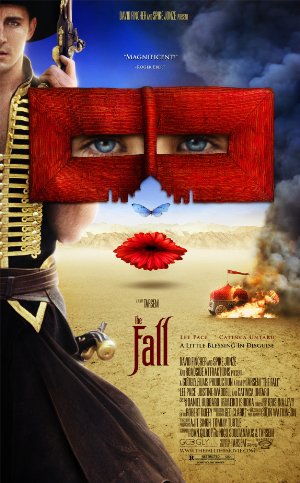
Facts and Figures
Year: 2008
In Theaters: Thursday 3rd January 2008
Box Office USA: $2.1M
Box Office Worldwide: $3.6M
Distributed by: Roadside Attractions
Production compaines: Roadside Attractions, Absolute Entertainment, Googly Films, Deep Films, Radical Media, Tree Top Films Inc.
Reviews
Contactmusic.com: 3.5 / 5
Rotten Tomatoes: 59%
Fresh: 62 Rotten: 43
IMDB: 7.9 / 10
Cast & Crew
Director: Tarsem Singh
Producer: Tarsem Singh
Screenwriter: Dan Gilroy, Nico Soultanakis, Tarsem Singh
Starring: Catinca Untaru as Alexandria, Justine Waddell as Nurse Evelyn / Sister Evelyn, Lee Pace as Roy Walker / Blue Bandit, Kim Uylenbroek as Doctor / Alexander The Great, Aiden Lithgow as Alexander's Messenger, Sean Gilder as Walt Purdy, Ronald France as Otto, Andrew Roussouw as Mr. Sabatini, Michael Huff as Dr. Whitaker, Grant Swanby as Father Augustine, Emil Hostina as Alexandria's Father / Blue Bandit, Jeetu Verma as Indian / Orange Picker, Leo Bill as Darwin / Orderly, Marcus Wesley as Otta Benga / Ice Delivery Man, Ayesha Verman as Indian's Bride, Robin Smith as Luigi / One Legged Actor
Also starring: Daniel Caltagirone, Tarsem Singh, Dan Gilroy