Faithless Review
By Rachel Gordon
Bergman showed a penchant for family drama with Fanny and Alexander and Wild Strawberries, among others. He enjoys mixing the imaginary world of his characters with their reality. This can lead to a deeper emotional entanglement with the characters; it's human nature to reflect and react based on internalized stimuli. Unfortunately for Faithless, Bergman is revisiting territory he excelled in some 40 years ago, without shedding any new light on his subjects.
This isn't the first film in which Bergman has written an old man getting close to the end and brooding with a fantasy companion about his wrongdoings. It's basically Wild Strawberries, only this time the crime is adultery instead of hubris. The main character is even sitting at a desk and writing constantly, again.
Bergman (the character, played by Erland Josephson) is an elderly gentleman who beckons Marianne (Lena Endre) to discuss her adulterous relationship with David. Marianne, an actress, and Markus (Thomas Hanzon), an orchestra prodigy, have been happily married. They have a young daughter, Isabelle (newcomer Michelle Gylemo), and David (Krister Henrikkson) is their best friend. David is a director and the stereotypical brooding, unhappy artist. One day David offhandedly suggested sleeping with Marianne, and when she went to Paris on a special project, he found reason to go as well, and their new relationship began.
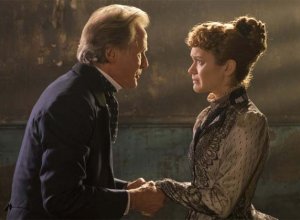
Bergman and Marianne journey through the entire story of the relationship. Often the camera cuts from the tense face of him to the tear-strained eyes of her. Every once in a while these moments are punctuated with a flashback sequence. In fact, the experience feels more like a play than a film, as screen time is consumed with the two sitting in a room and chatting away. The circumstances that brought Bergman to be the repentant weakling he is today and Marianne as his mirage take a back seat. Multiple takes of a man feeling horrible and a woman crying do not a film make.
Not to say that Faithless is a complete waste of time. When scenes that reflect on Isabelle come along, her innocence and quiet intelligence are well drawn. Because she gets to underplay the situation she has no control over, her plight becomes more important than that of her parents. This young amateur remarkably carries more presence in her silence than Marianne does with her tears.
Another fascinating point in the film is how simple and suddenly adultery can come to pass between two old friends. No easy excuse is made for it -- "trouble in the marriage" -- and the subsequent actions of the characters involved are realistically complicated. The film sticks to its story without attempting to pander to a mainstream audience.
For those who have never seen Bergman's work, this is not the place to start. A predecessor by some 40 years, Wild Strawberries is a more interesting story (even if it was shot in black and white) because the characters are more active, both in imagination and real time. They don't just sit around and brood all day but instead reflect based on external cues in their environment. That is what made Strawberries emotionally engaging. Perhaps if Faithless was told from beginning to end instead of through glimpses into a past, driven by tears, it would have hit half the nerves it was striving to.
Aka Trolösa.
Faith lost.
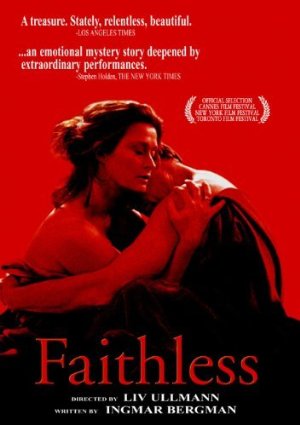
Facts and Figures
Year: 2000
Run time: 142 mins
In Theaters: Friday 15th September 2000
Production compaines: Metro-Goldwyn-Mayer (MGM)
Reviews
Contactmusic.com: 2.5 / 5
IMDB: 7.5 / 10
Cast & Crew
Director: Liv Ullmann
Producer: Johan Mardell
Screenwriter: Ingmar Bergman
Starring: Tallulah Bankhead as Carol Morgan, Robert Montgomery as William 'Bill' Wade, Hugh Herbert as Mr. Peter M. Blainey, Louise Closser Hale as First landlady, Maurice Murphy as Anthony 'Tony' Wade, Anna Appel as Mrs. Mandel, Second Landlady, Lawrence Grant as Mr. Ledyard, Henry Kolker as Mr. Carter, Geneva Mitchell as Party Guest (uncredited)
Also starring: Lena Endre, Erland Josephson, Krister Henriksson, Thomas Hanzon, Michelle Gylemo, Johan Mardell, Ingmar Bergman