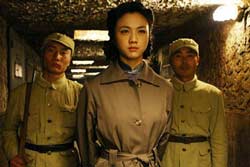
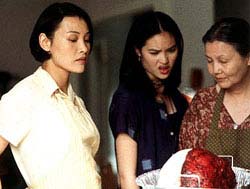
| Joan Chen doesn't look like a rebel this afternoon, whatwith her perfectly pressed, couture-quality, chiffon dress and the lengthof her flapper-style bob brushing a soft, spa-toned cheek. Nevertheless,she seems as braced for a barrage of questions as she must have been twoyears ago when she defied the Chinese government, filming her politicallyvolatile directorial debut on the sneak in Shanghai and on the Tibetanborder. An affecting condemnation of the Communists' 1970s CulturalRevolution policies as seen through the eyes of a teenage girl, "XiuXiu: The Sent Down Girl" has since beenbanned -- along with Chen herself -- from the country in which it takesplace. "I was ready to be kicked out any moment (during production),"she said with a look of brazen memory crossing her face. "I actuallykept a producer in the United States, so (if) I got kicked out...I wasfully prepared...to get everything ready for me (here). "Of course, if I got kicked out it would not be themovie you see today." The highly acclaimed film -- it swept the Golden Horseawards (the Taiwanese Oscars) and has been the buzz of several U.S. festivalssince late last year -- was also produced by Chen and adapted by Chen andYan Geling, the author of the short story on which the film is based. It accounts the plight of a happy-go-lucky teenager calledXiu Xiu, whose life is torn asunder when she's forced to leave her familyand is cast into effective servitude to learn a practical trade for thegood of The People. This "sent down" policy, as it was known by thepopulation it effected (mostly educated middle class Chinese who weren'tconnected enough to get strings pulled for their children), saw thousandsof kids leave home, many never to return again after they were strandedby this government directive which had by then outlived its usefulness. Chen and Yan, who became friends when Yan was writing Chen'sbiography, both grew up in this era and saw many friends dispatched toremote regions by this policy. "I think I was about 6 years old when I first sawneighborhood children being sent down," Chen says of growing up inChina in the '70s. "Geling joined the army at age 12. I was chosento be an actress at age 14. We were both luckier than Xiu Xiu." Played by a beautiful, spirited and talented 15-year-oldnamed Lu Lu -- the daughter of one of Yan's friends, who has won two bestactress awards for this performance -- the heroine of the film is exiledto the remote prairies of Tibet to learn cavalry from a reclusive, weather-beatenhorse herder. Made to live in a small, ramshackle army surplus tent ona hillside, and all but abandon by the government, she becomes disillusioned,turning to prostitution, in an attempt to bribe a pass home out of militarypassersby. The consequences, and her eventually abandon hope, are tragic. Now safe at home in San Francisco, where she lives withher physician husband, Chen recalls the steps she and her crew took toavoid detection by a government that disapproved so strongly of the storyin her film. "We worked from 7 at night to 7 in the morning (onthe sound stage scenes)," she says in a bold, still-defiant voicethat betrays her determination on this labor of love project. "Wewere like the vampires of the studio." So why did she risk the wrath of a repressive regime insteadof just shooting the movie elsewhere? Yan, who has come to the Bay Area to help Chen promotethe film, chimes in. "We went there (for) the scenery. She had anidea she might make it somewhere else, but she needed to see what Tibetlooks like." "I thought I could make it in America," Chencontributes. "But after she saw (Tibet)," Yan finishes, "shethought, 'no replacement.' Absolutely no place in the world looks likethat." Then Chen laughs, "Plus, where do you find yaks inAmerica? We (would have had to) put hair on bison or (do) makeup jobs forthe cows. And also, of course, Tibetan people around to give you authenticity." Told the uniqueness and remoteness of the landscape comesthrough beautifully in the film's breathtaking, panoramic cinematography,the rookie director smiles and says, "It was really an interestingpart of the story because of the isolation that was so real. (Xiu Xiu)was completely isolated, and I felt it (there)." The fact that it the film captures that isolation was somethingshe didn't know for sure until long after the shoot was over and she hadreturned to the United States to edit the film. Because they were shootingsecretly, she did not develop or look at a foot of celluloid until shewas safely home. So that's the story of how she completed the film. Buthow it begin? "(Geling) told me the story before she wrote it, andI found it very compelling." Chen says, glancing with admiration ather friend. "And when I read it, it was astoundingly beautiful. Shehas a genius for words, but also, the way it was written was very visual,very sensual, and I could picture a poignantly beautiful film just by readingit." Then in 1996, while serving on the jury at the Berlin FilmFestival during a year apparently featuring a lopsided number of dark films,Chen began writing the script. "I gave (Geling) a call from Germanyand said 'Oh, all these urban despair movies!' I wanted to get out thereto the Tibetan sky and I wanted to transfigure something different andbeautiful." "Xiu Xiu" became her directorial debut, saysChen, because "I love this story, and there was no other responsibilityI could assume." "I couldn't play anything in the film (none of thecharacters are her age) and wanting to tell the story, I decided to writethe script. Then (Geling and I) worked on it together, then we went toTibet together. When I was in front of this piece of sky and terrain, themovie was born to me." With "Xiu Xiu" so well received, directing issomething Chen intends to do again very soon -- she and actress Gong Li("Chinese Box") are planning to shoot another Chineselanguage film called "Fusang" -- but she would rather stay awayfrom producing in the future. "The raising of money is not what I do best. I can'teven keep a straight account for my house. My husband pays the bills. Theproducing part, the details of finance, I would never do again." As for braving the official wrath of the world's secondmost populous nation, that's probably behind her as well, although asidefrom the pain of her banishment, as far as Chen knows, there's been relativelylittle backlash against her cast and crew, all of whom still live there. "I talked to Lopsang (the actor who played the herder)and he said they had him interviewed, investigated and wrote sort of aself-criticism, but that's it." |