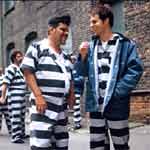
| In Welcome to Collinwood, the first feature film from Cleveland natives and co-writer/directors Joe and Anthony Russo, Collinwood is not just the landscape for a rare mix of tragedy and comedy, it's a part of the cast. "We set the story in a traditional working class neighborhood of Cleveland, the kind of neighborhood that's interesting because of its archaic feel," says Anthony Russo, who, along with his brother, won the attention and support of Academy Award-winning director Steven Soderbergh (Ocean's Eleven, Traffic, Erin Brockovich) after he saw their student film Pieces at the 1997 Slamdance Film Festival. "Because this story is a fable, we didn't want a specific or recognizable time setting, and Collinwood was perfect for conveying something indefinite in time and space." Soderbergh, who produced Welcome to Collinwood with partner George Clooney, agreed that the proper atmosphere couldn't be captured on a studio backlot. "I thought shooting on location was very, very important, because I didn't want it to feel like other movies, and I didn't want it to look like other movies. Welcome to Collinwood doesn't look like your typical film because it's shot in Cleveland and Collinwood, which results in an authenticity that is really integral to the movie." The Russos' journey from their Cleveland roots to directing their eight million dollar action adventure comedy is, according to Collinwood executive producer Casey La Scala, "a fairy tale - with two fairy godmothers - Steven Soderbergh and George Clooney." Their amazing Cinderella story began in 1997, when Soderbergh caught a screening of the film Pieces, a black comedy about three crazed Italian brothers in a failing Cleveland hairpiece business. A week later, the brothers received a phone call from Soderbergh. "We couldn't believe it," remembers Joe. "Steven said that he wanted to produce our next project, and he told us, 'there are two routes you can take in Hollywood: you can write your own script to direct - or we can try and get you connected to another screenplay.' We said we would prefer to direct our own material, and we began writing intensely over the next couple of years." Anthony then takes up the story, explaining that "when Steven and George formed their Section Eight production company, they brought us in and said they wanted to make one of our films. That film ended up being Welcome to Collinwood." "When I saw Pieces," Soderbergh relates, "I thought it was energetic and creative, but also very well thought out and organized - not just a collage of effects. Then when I read Collinwood, I liked the structure of it; it had a plot and an approach to the characters that I thought was well developed, with a great set-up and payoff. Intelligent comedies are very hard to write and I thought it was really well built." Collinwood is evocative of the ensemble comedies of the 1930s - the terrible conditions that existed during the Great Depression drew storytellers to the most hard luck neighborhoods and the desperate situations of the people who lived there. "These movies, like the Dead End Gang movies, were some of our favorites," says Joe, "because of their simplicity and innocence and faith in the human spirit to transcend even the most absurd of life's conditions. It was the stories of the people from places like this that drove us to write and direct Collinwood." "Collinwood reminds me of Preston Sturges' films," comments Soderbergh, "such as Hail the Conquering Hero or The Miracle of Morgan's Creek - the sort of multi-character comedies in which you have a real sense of each person. The audience spends some time with them and they're very well drawn." One film in particular inspired the Russo brothers' story about down-and-out characters trying to pull off a too-good-to-be-true robbery. "Collinwood borrows very heavily from Big Deal on Madonna Street," says Joe, "an old Italian comedy that we transplanted to Cleveland. We've been enormous fans of the film all of our lives, and we thought it was such a tragedy that American audiences had never really experienced this classic comedy. That of course led us to the notion that by remaking it, we could potentially bring the story to people who would never see it otherwise." The support of producers Soderbergh and Clooney has been instrumental in affording the Russos an opportunity to further develop their potential as filmmakers. "Steven and George are trying to create an environment where you can combine the best of the studio world and the best of the independent world in a single vision," says Anthony. "That's exactly what we've always wanted to do. They've created a company that can support filmmakers like us, and it has been an extremely valuable resource." CASTING Besides attracting financing and mentoring the Russos, Clooney and Soderbergh also helped to secure a stellar cast. "Steven identified the Russo brothers as extraordinarily talented directors, and that drew in these very experienced actors who typically have their pick of projects," notes executive producer Ben Cosgrove. "And the fact that George chose to play a small role in the film was very influential in Warner Bros. Pictures' and Gaylord's decision to finance the movie." Although they wrote the screenplay with the intention of attracting high-caliber talent, the Russos are nonetheless amazed at how successful they were. "The movie, at its essence, is an actor's piece," says Anthony. "That was our approach to casting. We really wanted to find 'actors' actors' to play these roles because we felt the script needed it." "We've kept a mental list of all our favorite actors from over the past decade," says Joe. "And those are the actors that we went after for the film. Insanely enough, they actually said 'yes.' At first, being on set was incredibly intimidating, but everyone treated us with such a high level of professionalism that we were able to move beyond our awe and get down to business." "If you ask me why I was attracted to this project, I'll tell you 'It's the script,'" says veteran character actor William H. Macy. "It reads like it's contemporary and at the same time like it's a Thirties comedy. It moves wonderfully, with great humor and great affection towards the characters, and with an underlying morality, which I found completely disarming. I've always been attracted to the story of losers who get their shot." Soderbergh also feels that a lot of the film's strength lies in the way the actors' performances persuade the audience to root for the hapless criminals. "When you have some sort of emotional investment in the characters the outcome becomes important to you. And that's where I think Collinwood really stands out - once they get to the last part of the film you desperately want them to pull this thing off because you know how much they need this to happen." | 







![Luke De-Sciscio talks to us about having the courage to be yourself, forgiving that which is outside of one's control and following whims [EXCLUSIVE]](https://images.contactmusic.com/images/home/homepage/luke-de-sciscio-abof-a.jpg "Luke De-Sciscio talks to us about having the courage to be yourself, forgiving that which is outside of one's control and following whims [EXCLUSIVE]")