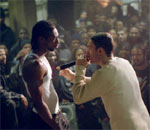
| Survival is key in the harsh lower depths of Detroit, and for many, the current emotional life preserver is hip hop. As an art form, rap music is impromptu and fast-paced, topical and insightful, requiring skills of language, nuance and keen observation, as well as emotional truth. For people like Jimmy Smith, Jr. (Eminem), hip hop is the only thing standing between him and the void. In the absence of nurturing parents, Jimmy and his friends – cool and charismatic Future (Mekhi Phifer), optimistic dreamer Sol (Omar Benson Miller), aspiring activist DJ Iz (De’Angelo Wilson) and slow but steady Chedder Bob (Evan Jones) – have created their own family. Jimmy and his “crew” (Three One Third), live on hopes of “getting that big deal soon,” while struggling to eke out a living at their dead end jobs and navigating the minefields of their turbulent personal relationships. As Jimmy so bluntly puts it: “we’re all broke as shit and living at home with our moms.” At night, they feed their dreams in the hip hop clubs of Detroit where the city’s best rappers battle each other with emotionally abusive rhymes as they vie for the respect of their peers. In the un-poetic world of Three One Third, rhyme is wielded like a weapon with words meant to wound. And victory belongs to the quick-witted. The world of Detroit’s hip hop clubs is one that 8 Mile star Eminem knows well: “I remember, if I lost a battle, it would be like my entire world was crumbling. A lot of people would say, ‘What’s the big deal? Get over it. You lost, try again.’ But I would feel like my whole life was over. It’s competition. It’s like a sport that is somebody’s whole life. It may look silly to a lot of people, but to a lot of us, it’s our world.” In 8 Mile, Jimmy has the skills he needs to win. But he needs to find his voice and channel his anger into his music. "My character, Jimmy, is really hot-headed,” said Eminem, “which is how I used to be, and I guess still can be at times. His emotion constantly gets the best of him." But as Jimmy finds his voice, he also begins to find his way and a will to pursue the new roads that will take him beyond the boundaries he can no longer live within. Fascinated by the hip hop world, producer Brian Grazer had long been convinced that it had enormous dramatic potential which had never been fully explored on film. He was determined to develop a story that would bring its power, energy and truth to the screen. “I’ve been interested in hip hop for more than 20 years,” explained the producer. "I got introduced to the music of Slick Rick, who was this absurd hip-hop artist who told perverse stories in his songs that had humor and truth. That’s what made me want to discover more about the roots of hip hop, how it works, what the lyrics are relevant to. This was before it became a multi-billion dollar industry.” Grazer knew that for a film about this world to work, it was essential to find the right rap artist. As destiny would have it, Grazer's laser focus fixed on the brilliant and controversial rapper Eminem at exactly the same time that the rapper was searching for the right project in which to make his motion picture debut. Eminem and producer Jimmy Iovine had listened to countless film pitches but nothing connected for them until they met Grazer. According to Iovine, “We kept hitting the ball and Brian Grazer was the first guy to hit it back.” “I became interested in Eminem several years ago,” Grazer remembered. “He wasn’t a star at the time, but I felt he had enormous charisma and that he could be explosive as a film star. I got him in my office, and he just wouldn’t talk. He wouldn’t even look at me. After about 15 minutes, he finally engaged. And once I got him talking, he was fantastically articulate and eloquent.” With Eminem on board, Grazer engaged the services of screenwriter Scott Silver, whose independent film johns was imbued with a street-smart realism that impressed Grazer as having qualities similar to what he was seeking in 8 Mile. Noted Grazer, “Just as you don’t have to appreciate boxing to like Rocky or Raging Bull, you don’t have to be a hip hop fan to appreciate 8 Mile. It's about human endurance, tenacity, getting into this world and surviving it." For director Curtis Hanson, 8 Mile was an opportunity to once again explore a unique stratum of American culture, to peel back its layers and take a look at people struggling to find their way: "In 8 Mile, we are exposed to a world little known or visited in film, or in mainstream news coverage: impoverished America struggling to make it legitimately in the recesses of the inner city. The people in Detroit know 8 Mile as the city limit, a border, a boundary. But for the character of Jimmy, 8 Mile is the psychological dividing line that separates him from where he wants to be and who he wants to be. If you think about it, we all have our own 8 Mile.” While the characters and plot of 8 Mile are fictional, the world of Jimmy Smith Jr. is one that Eminem knows well: “8 Mile separates the city from the suburbs. To grow up as a rapper, to grow up on the Detroit side as opposed to the suburban side gives you credibility. It’s a big deal. And if you don’t listen to hip hop, you just don’t care, it’s not a big deal to you. But if you’re in it, let me tell you, it very much is.” Eminem's motion picture acting debut began with a six-week rehearsal schedule. “Curtis had a pretty unique rehearsal process,” said Eminem. “I wouldn’t say ‘unique’...I’d say ‘grueling.’ We rehearsed for over a month straight, of just doing the lines and trying different ways to do them. It gave all of us a chance to get to know each other … I don’t want to sound corny, but Curtis is great at what he does. He’s one of those directors who, when you think you know how a scene should play, there’s always a way that he will come up with that is different than what you thought, and better.” Hanson has nothing but praise for the rapper’s acting debut: “Marshall gave me all a director could ask for from an actor – enormous talent, focus, dedication and a total commitment to the story we were trying to tell. He came at the job with humility, respect and tremendous self-discipline. No matter how difficult the circumstances, he was always determined to do his best and to find the truth in every moment.” In his quest to find the perfect actress to portray Jimmy’s mother, Stephanie, Hanson turned to Kim Basinger, who won an Academy Award®, Golden Globe Award and Screen Actors Guild Award for her performance in Hanson’s L.A. Confidential. Basinger readily accepted the invitation. “It was a second gift to me to be able to work with Curtis again,” said Basinger. “It is the most sincere collaboration I have ever experienced. I cannot think of anyone more talented or worth one’s trust than Curtis Hanson, especially being the insecure artists that we are, always in search of someone to believe that we can do it with the right guidance. He’s so supportive – a humble, beautiful person with the excitement of a kid, a great friend and a little bit of a mystery – a wonderful combination. I am thankful I know him.” Hanson also reached out to a number of vital young performers, who were all more than willing to reach back. “I went in and met with Curtis a few times,” remembered Brittany Murphy, who received critical praise for her performance opposite Michael Douglas in the suspense thriller Don't Say a Word and co-starred with Drew Barrymore in Riding in Cars with Boys. “He was absolutely lovely. I loved the story ... I thought it was representing a piece of our nation that hasn’t really been shown on film yet, and a great story about a young man with a massive amount of energy trying to figure out what the outlet is for him to better himself. I think that any performer would understand this need. There’s a way to use all that energy as opposed to letting it eat you alive, and that’s Jimmy Smith’s struggle in the story. “Curtis had a really interesting way of going about rehearsals, and I loved what he did,” Murphy continued. “In a way, I see him as a grand puppet master ... he’s a very mysterious man. There was a beautiful sense of everyone getting to know each other. Everyone truly became friends and got to know everyone’s tics. To be the only girl with all those silly guys was fun and crazy. I would stay in after I had finished rehearsing my scenes and watch their rehearsals, because it was just too much fun.” Recalled Mekhi Phifer, who emerged as a major film talent when director Spike Lee and producer Martin Scorsese cast him as the lead character in their movie adaptation of Richard Price's Clockers: “When they first told me about the project, I wasn’t excited. I didn’t even want to read it. I thought it was going to be a rapper movie, and I’m not interested in doing that type of film. But after meeting Curtis, I learned that 8 Mile is comedy, it’s drama, it’s action, it’s multi-genre. It’s about finding your own way, what really makes you happy, pursuing your dreams and not letting your talent go to waste.” The backdrop and rehearsal process swept the actors into a kind of crusade for truth that brought art and life together. “We came to this project with no false pretenses,” said Phifer. “We came with our passion, ready to work. We came to better the project and make it our own. Rehearsals helped define our relationships. We changed and enhanced the dynamics between the characters, making them stronger and understanding their motivations.” Hanson’s overriding goal throughout production was to make the movie feel authentic: “I wanted the movie to feel real. Natural. Almost documentary-like. I loved exploring the world this story takes place in and I wanted the audience to feel that they actually went into that world, too.” His crew was chosen with this primary mission in mind. In order to capture the reality he was seeking and the authentic texture of Detroit, Hanson selected a group of collaborators who straddle the line between independent and mainstream cinema, including Mexican-born cinematographer Rodrigo Prieto (Amores Perros, Frida), production designer Philip Messina (Ocean’s Eleven, Traffic, Erin Brockovich), costume designer Mark Bridges (Boogie Nights, Punch-Drunk Love) and film editors Jay Rabinowitz (Requiem for a Dream, Affliction) and Craig Kitson (Wonder Boys). Prieto’s much praised work in Alejandro Gonzalez Inarritu’s Amores Perros impressed Hanson with its realistic depiction of life on the streets of one of the world’s toughest urban environments, Mexico City. “After doing period pieces like Frida and Original Sin,” said Prieto, “I was excited to do another urban film more in the style of Amores Perros. Curtis said that he wanted 8 Mile to look and feel ‘like a weed emerging from the sidewalk.’ I really loved that image.” “When I first read the script,” recalled Messina, “my initial feeling was that it was set in a world that was kind of alien to me. But Curtis made it clear that we weren’t going to make a ‘rap movie.’ We were going to make a movie about a journey. Then I knew that I could delve into a world that I hadn’t been exposed to before, and try to make it really ring true. The most important task, from the design point of view, was to make it real.” While there were initial discussions about shooting the film somewhere other than Detroit, these plans were quickly rejected. Explained Brian Grazer: “It was very important to make this movie in Detroit, particularly for Curtis, who wanted it to feel as authentic as it possibly could. And after seeing the film, you can see that it couldn’t have been done in any other place.” Making a movie in Detroit isn’t easy. Making a movie in Detroit in the middle of winter is a challenge. Nonetheless, the artists behind 8 Mile found themselves quickly falling in step with the city. “Getting to know Detroit was a revelation,” said Hanson. “Everywhere you looked you’d see evidence of the city that used to be – the city that promised a future to all who came there and now appeared to promise nothing. It was the perfect setting both visually and thematically for our story.” For 8 Mile, Hanson and Prieto developed a disciplined, yet free form approach to capturing the drama. “When things aren’t perfect, it’s more spontaneous,” said Prieto, “and that’s the way we approached the photography. Curtis and I talked about the way these guys live and how they do free-style rapping, and that’s the way we shot it – free-styling, with a lot of improvisation. We did almost all of it with hand-held camera. It gave freedom to the camera, not confining it to a track or a tripod. You can move around as things happen, with the camera adapting to the situation and organic as to what the actors are doing. We’re not doing complicated dolly or crane shots, and generally not doing establishing shots of locations either. We discover Detroit through the characters.” The cinematographer added: “Curtis has really been great. He listens to whatever we have to say, as a team. He has his ideas about how he wants to do it, but always asks for our opinion. And when he thinks it’s correct, he’ll do it without hesitation. He has no ego ... it’s all about the movie and the end result.” Production designer Messina was dazzled by the multitude and variety of looks that Detroit offered. The variety may be largely due to the unusual number of vacant or recycled structures that remain as architectural reminders of Detroit’s illustrious past. Office buildings from the turn of the century stand empty and unused or in some cases have been gutted and converted to condominiums. Churches have become restaurants. Mansions dating back to the Model T are now nursing homes or community theaters. This tendency to incorporate and expand upon what came before rather than raze and start completely anew is not only a Detroitism, it is also a concept central to hip hop, where the use of beats and samples from the music of the past is key. As Nelson George notes in his book Hip Hop America, hip hop “is a postmodern art in that it shamelessly raids older forms of pop culture – Kung Fu movies, chitlin’ circuit comedy, 70’s funk and other equally disparate sources – and reshapes the material to fit the personalities of an individual artist and the taste of the times.” Hanson and Messina decided to build on this idea and showcase many of Detroit’s structures that have had a past life, or in some cases lives, reflecting how the city has struggled to survive and reinvent itself over the years. One example of this phenomenon is the Michigan Theatre, which opened in 1926 and went through several incarnations as a supper club, nightclub and finally, a parking garage, which Messina described as “one of the most bizarre things I’ve ever seen in my life. The theatre was literally gutted from the roof down, with about a quarter of its proscenium intact with tattered curtains hanging over it, and the rest is a three-level parking garage. We really fell in love with it and it became a key location.” The filmmakers also found and then resurrected the Chin Tiki in its original location, where it had closed years before. “It was almost as if someone had just walked away from it on a Saturday night,” recollected Messina. “There were still liquor bottles at the bar, and matchbooks out. The owner was there the night we were shooting, and he was almost crying, seeing his restaurant bustling again and filled with activity.” Another key location is the “abandoned house” where a little girl has been raped, prompting its torching by Three One Third. While such acts of arson are still a fact of life in Detroit, in 1995 they were epidemic, with more than 4000 incidents reported, many of them on “Devil’s Night,” a prelude to Halloween. “A lot of those derelict and abandoned structures became drug zones and crack houses, very dangerous for people in the neighborhood,” explained De’ Angelo Wilson. “And the city wouldn’t or couldn’t focus on the problem. So for my character, DJ Iz, who sees himself as a political militant, burning the house down isn’t fun… it’s a statement.” For Jimmy, it’s an emotional turning point, prompting him to reflect on the abandoned house’s previous incarnation as a family’s home and, by extension, on the family life he never had. www.uip.co.uk www.8-mile.com |