Waking Life Review
By Max Messier
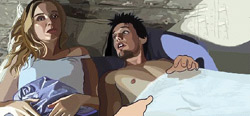
Most people will not understand Waking Life. Some will find it to be one of the most brilliant pieces of film ever produced. I found it to be beyond words; a combination of film, groundbreaking computer animation, and a difficult and profane script that produces a sublime interpretation of existence.
The film loosely follows the exploits of a young man (Wiley Wiggins) who is faced with the realization that the life that he living is only but a dream, or a series of dreams states with an unknown purpose. The film follows Wiley as he controls an omnipotent perspective into complex personal diatribes, candid conversations between lovers and friends, and one-on-one discussions with over 60 colorful characters, Slacker-style, crisscrossing and intersecting through his dream states.
In these dream states, Wiley covers complex issues which range from the purpose of collective memories; the integration of man and machine into one equal being; the purpose of God and death in the human psyche; the joys of living in this imperfect world; the notions of memory control based upon evolution; and free will in relation to theological and physical limitations. During these interactions, Wiley slowly discovers his own destiny within these dream states and of the consequences one must face with that knowledge. All of these soapbox speeches sometimes lead to the profane, illogical, and rambling notions of a crazy person. The impact, though, is phenomenal.
The writer and director of the film Richard Linklater, best known for Slacker and Dazed and Confused, tackles heavy subject matter and succeeds admirably. Linklater's attempts in answering some of life's most complex issues are achieved superbly; his conversation pieces even manage to reach plausible conclusions in a short amount of time.
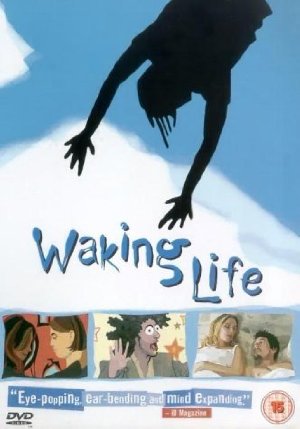
The metaphysical expressionism of the film is made even more powerful by the awe-inspiring animation work of Bob Sabiston, who created unique "interpolated rotoscoping" software to give Wiley's dream world a surreal and Dali-esque movement and feeling. In every scene of the movie, all stationary items such as tables and chairs seem to float, refusing the laws of gravity. Characters are either given great detail or are reduced to resemble child-like drawings that would hang on the family refrigerator. The film feels like you're watching a combination of the works of Basquiat, Picasso, and Warhol brought to life.
Beneath the drawings, the film is shot in real life using real actors, including Julie Delpy, Ethan Hawke, and Adam Goldberg. Over 30 artists were then brought in to paint over individual characters of the film using Sabiston's animation software. The result is proof that both the painter's brush and the filmmaker's eye can combine to achieve visions of wonder and profoundness.
Bedbuds.
Facts and Figures
Year: 2001
Run time: 99 mins
In Theaters: Thursday 7th March 2002
Box Office USA: $2.1M
Box Office Worldwide: $3.2M
Distributed by: Fox Searchlight
Production compaines: Line Research, Fox Searchlight Pictures, Independent Film Channel (IFC), Thousand Words, Flat Black Films, Detour Filmproduction
Reviews
Contactmusic.com: 5 / 5
Rotten Tomatoes: 80%
Fresh: 113 Rotten: 28
IMDB: 7.8 / 10
Cast & Crew
Director: Richard Linklater
Producer: Anne Walker-McBay, Palmer West, Jonah Smith, Tommy Pallotta
Screenwriter: Richard Linklater
Starring: Wiley Wiggins as Main Character, Ethan Hawke as Jesse, Julie Delpy as Celine, Ken Webster as Bartender, Adam Goldberg as One of Four Men, Steven Soderbergh as Interviewed on television, Bill Wise as Boat Car Guy, Charles Gunning as Angry Man in Jail, Caveh Zahedi as Caveh Zahedi
Also starring: Peter Atherton, Steve Brudniak, John Christensen, Nicky Katt, Louis Mackey, Steven Prince, Anne Walker-McBay, Palmer West, Jonah Smith, Tommy Pallotta, Richard Linklater