The Battle of Algiers Review
By Jules Brenner
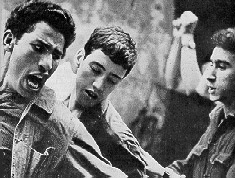
Because of that relevance, new prints from the original negative have been struck for theatrical re-release, that we might all judge and reconsider its instructions and its messages. One of these is that the battle for hearts and minds can't be won so easily by a rebellious people when sympathetic observers can taste the malice behind the deaths they cause, no matter what the political context.
In a prologue, French military interrogators apply pressure to an old Algerian nationalist until he reveals the hiding place of the last remaining guerrilla leader, Ali La Pointe (Brahim Haggiag). When his hideout is efficiently surrounded, La Pointe hides in a blind behind a wall, which is quickly discovered. He's given a choice to come out or die. As he contemplates his options, we flashback three years, to the point of origin of the conflict, when the National Liberation Front, the NLF (aka FLN), issued a proclamation calling the population to unite in a struggle for independence.
Soon thereafter, the strutting, heroic figure of French Colonel Mathieu (Jean Martin), a character based on Jacques Massu, the actual commander of the French forces, arrives with his elite force of French paratroopers to deal with the problem. In a strategy virtually paralleling the one that Colonel James Hickey used in Iraq to find Saddam Hussein, Mathieu outlines for his troops the cleverly compartmentalized structure of the Algerian NLF's command and charges his men to find the foot soldiers of the rebellion. Through coercion and torture, they will force these lower level terrorists to identify the leader of their cell and his location amidst the native sympathizers.
In this way, the French troops gradually expose the hierarchy of tactical cells and eliminate them one by one, though not without some loss to themselves. When the story leads back to the last of them, La Pointe chooses death over surrender and the Battle of Algiers ends. While this squashing of a persistent enemy force represented a victory for the French, the cause of the revolution didn't die. The complaints of inequality and suppression remained, and the roots of rebellion sprouted again three years later leading, finally, to Algeria's independence in 1962.
Pontecorvo's characters are political figures first and foremost. While they tend to be two-dimensional archetypes, they serve to concentrate our interest and arouse complex sympathies. The balance of viewpoints is the most stunning accomplishment of Pontevorvo's film, elevating its effect far more than if it had told the story from only one side.
High-speed cutting, amateur actors culled from the environment, extraordinary coverage in the streets, back alleys and safe houses of Algiers' Casbah, details of the grass roots movement as it grows into a well organized instrument of mortal danger, all of these elements lend the film the aura of a documentary and the sense of historical accuracy. The drama it develops tends to overcome what might appear to a modern eye as awkward formality in the characterizations.
Underlying the film's insights is the fact that some of the actors were actually involved in the Algerian struggle, most notably, producer Yacef Saadi's part of El-hadi Jaffar, which is based on his real-life role as a general in the NLF. It was Saadi's original treatment for the film -- written in an Algerian jail after capture by the French -- which provided the basis for Pontecorvo's and co-writer Franco Solinas' screenplay. The tense score was composed by Ennio Morricone.
This lesson in modern warfare is not only instructive to the Pentagon's military but is of considerable value to any generation's fascination with law, order, anarchic behavior, and classic storytelling technique.
The Criterion edition DVD offers three full discs of material on the film and the titular Algerian struggle. Seven documentaries -- from 17 to 69 minutes long -- weigh in on the film's influence on contemporary directors, the Algerian experience during these years, an expose on tortures of the era, an investigation into terrorism, and several more. A 1992 documentary returns to Algiers to examine what 30 years of independence have done to the area's people -- and a 55-page booklet puts most of this in printed form. Whew!
Aka La Battaglia di Algeri.
Angry in Algiers.
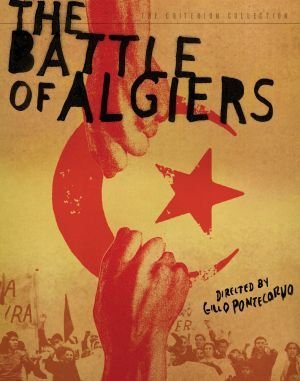
Facts and Figures
Year: 1965
Genre: War
In Theaters: Wednesday 20th September 1967
Box Office USA: $0.2M
Box Office Worldwide: $921.5 thousand
Distributed by: Rialto Pictures
Production compaines: Igor Film, Casbah Film
Reviews
Contactmusic.com: 4 / 5
Rotten Tomatoes: 99%
Fresh: 75 Rotten: 1
IMDB: 8.2 / 10
Cast & Crew
Director: Gillo Pontecorvo
Producer: Antonio Musu, Yacef Saadi
Screenwriter: Gillo Pontecorvo, Franco Solinas
Starring: Brahim Hadjadj as Ali La Pointe, Jean Martin as Col. Mathieu, Yacef Saadi as Djafar, Ugo Paletti as Captain, Fusia El Kader as Halima, Samia Kerbash as One of the girls, Mohamed Ben Kassen as Petit Omar
Also starring: Brahim Haggiag, Tommaso Neri, Antonio Musu, Gillo Pontecorvo, Franco Solinas