American Graffiti Review
By David Bezanson
A cinematic collection of slightly exaggerated memories from Lucas' senior year in high school (1962), Graffiti was well-timed; it caught a wave of fifties nostalgia that would crest with Happy Days, Grease, etc. While the iconoclasm of the sixties and seventies would continue to take youth culture in a very different direction, Graffiti helped spark a cultural backlash (or at least a flashback) after the free-love/acid-rock/anti-war era.
The autobiographical Graffiti was perhaps an easy film for the young director to make, but it's still a good film, and nothing good is ever easy. The storyline is fairly thin, but it is as it was -- a faithful depiction of drag racing and drive-ins, boredom and lust, the anxieties and dreams of small-town America in the early 1960s. The weekend rituals of Lucas' teenage hotshots and losers are set to an awesome soundtrack, the pop/rock & roll that was always on the radio in the early sixties -- a diverse continuum which included the Beach Boys' SoCal harmonies, Chicago R&B, Northeastern doo-wop and Texas rockabilly (so different from the Balkanized formats of today's radio). The songs which constantly play in the background in Graffiti are perfectly chosen and capture the moment when the musical tastes of white and black America finally merged.
The film gets the details mostly right, and the parade of classic cars demonstrates that Lucas was a true gearhead who once considered car racing as a vocation. Most important, Lucas's direction and pacing are (or at least were) flawless. With its large cast of young and hungry actors, Graffiti launched several careers (not only Ford but also Dreyfuss, Cindy Williams, Suzanne Somers, Kathleen Quinlan, and others).
Lots of people have sneered at the American culture of the fifties and early sixties -- examples are too numerous to mention, from opinion makers like historian David Halberstam to films like Pleasantville -- and we are supposed to believe it was a time of naiveté and paranoia and injustice. Well, screw 'em. The fifties and sixties were the last time when cultural aspiration was still cool, and to someone growing up today, the difference between then and now seems huge, and unfavorable. It was an era of dreams and possibilities -- Chuck Berry and Miles Davis were reinventing music and MLK was leading the civil rights movement during the same years that the first heart surgeries were performed and von Braun was building the rockets to the moon. The average Americans depicted in Lucas' film were unaware of all the ground that was being broken, but they shared the confident attitude and restless spirit of the time. American Graffiti is a successful tribute to an era of optimism and competitiveness which was bitchin' -- and now seems very far in the past.
Facts and Figures
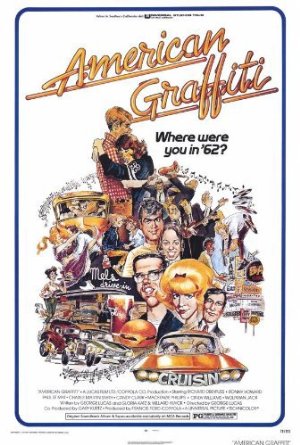
Year: 1973
Run time: 110 mins
In Theaters: Wednesday 1st August 1973
Box Office Worldwide: $115M
Budget: $777 thousand
Distributed by: Universal Pictures
Production compaines: Universal Pictures, Lucasfilm, The Coppola Company
Reviews
Contactmusic.com: 4 / 5
Rotten Tomatoes: 95%
Fresh: 41 Rotten: 2
IMDB: 7.5 / 10
Cast & Crew
Director: George Lucas
Producer: Francis Ford Coppola, Gary Kurtz
Screenwriter: George Lucas, Gloria Katz, Willard Huyck
Starring: Richard Dreyfuss as Curt Henderson, Ron Howard as Steve Bolander, Paul Le Mat as John Milner, Charles Martin Smith as Terry 'The Toad' Fields, Cindy Williams as Laurie Henderson, Candy Clark as Debbie Dunham, Mackenzie Phillips as Carol, Wolfman Jack as XERB Disc Jockey, Bo Hopkins as Joe Young, Manuel Padilla Jr. as Carlos, Beau Gentry as Ants, Harrison Ford as Bob Falfa
Also starring: Suzanne Somers, Kathleen Quinlan, Francis Ford Coppola, Gary Kurtz, George Lucas, Gloria Katz, Willard Huyck