Godzilla (1954) Review
By Don Willmott
It's about time. Deemed unsuitable for American release in 1956, distributors chopped 40 minutes out of the film, dubbed the rest of it poorly, and then added 20 minutes of Raymond Burr in the new role of an American journalist observing the action and adding his own absurd commentary.
What was the problem with the original version? Well, now we know. Godzilla is much more than the rampaging monster fest that inspired a thousand more rampaging monster fests. It's a trenchant anti-war and anti-nuclear testing screed (with some implied anti-Americanism tossed in) that would have been way out of sync with the catch-the-Commies Cold War vibe of mid-'50s America. Watch a movie that suggests H-bomb testing is a bad idea? Hell, no! We gotta build a bigger bomb before the Russkies do!
It all begins with a mystery. Ships off Japan are being destroyed, and only after a survivor washes up on shore do the authorities get a hint that some kind of "monster" may be involved. Eager young marine salvage expert Ogata (Akira Takarada) and his skittish girlfriend Emiko (Momoko Kochi) are soon on the case, as is her father Yamane (Takashi Shimura), a paleontologist with some interesting theories.
An investigation team heads for an island where a village has been destroyed by something that definitely wasn't a typhoon. Scientists find giant footprints, and their Geiger counters go crazy. Bad news: Whatever it is, it's big and it's radioactive. Godzilla ("Gojira" in Japanese) then makes his first appearance by peeking demurely over a mountaintop. The team beats a hasty retreat and heads back to Tokyo with their findings. It's obvious the monster has been awakened from his hibernation by underwater H-bomb testing.
Watching the government officials frantically debate what to do is fascinating, and their questions echo across history to our own troubled times. Should the public be told everything? Will panic ensue? What's the best defense against an unknown attacker? Yamane argues that Godzilla should be studied rather than killed, but he has few supporters. The military sets out to build the world's largest electric fence and sends all its artillery to the harbor shore. Meanwhile, like today's airline passengers stuck in long security lines, the Tokyo citizenry seems more annoyed than frightened. In one funny/scary scene, commuters on a train bitch and moan about evacuation. What a hassle! It's always something!
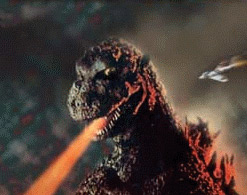
Eventually, of course, Godzilla lets loose on Tokyo, using his famously hot breath to torch large swaths of the city with epic destructive power that must have reminded 1954 moviegoers of the Tokyo firebombings of just nine years earlier. The special effects are as primitive as you remember, but it's impossible not to admire the craftsmanship that went into them, and a true sense of horror builds as the masses panic in the streets. (As other reviewers have pointed out, some of these extras were acting from personal experience.) A young mother cowering with her two children and awaiting certain incineration says, "Don't worry. We'll be with Daddy soon." You have to wonder how 1950s audiences in Hiroshima and Nagasaki responded to these scenes.
Discussion turns to a mysterious gadget called the Oxygen Destroyer created by Serizawa (Akihiko Hirata), a brilliant scientist (and Emiko's ex-boyfriend) who carries his own physical scars from World War II. He knows it can be used to stop the beast, but he's afraid to go public because he knows that once "politicians" see its power, they'll want to weaponize it and compel him to build more. His moral dilemma is written all over his face. Should he save the city but endanger the world?
Godzilla is a movie way ahead of its time. It presages the kinds of disarmament debates that didn't pick up steam until 20 years after its release. The edited version may have thrilled and scared Americans, but it didn't tell them anything. Over time it became something of a joke, a situation exacerbated by the increasingly cheesy string of color sequels that introduced a whole menagerie of rubber monsters who fight amongst themselves, destroying everything underfoot in the process.
This golden anniversary is the perfect time to go back to where it all began in beautiful black and white, to understand the filmmakers' original intentions, and to appreciate the storytelling power they brought to bear in unleashing Gojira on the world.
Aka Gojira; Godzilla, King of the Monsters.
Godzilla smash!
Facts and Figures
Year: 1954
Genre: Horror/Suspense
Reviews
Contactmusic.com: 5 / 5
Cast & Crew
Director: Ishiro Honda
Producer: Tomoyuki Tanaka
Screenwriter: Ishiro Honda, Shigeru Kamaya, Takeo Murata
Also starring: Takashi Shimura, Akira Takarada, Momoko Kochi, Akihiko Hirata, Tomoyuki Tanaka, Ishiro Honda, Shigeru Kamaya, Takeo Murata